

Why aren't my recommendations landing?
Three ways to make policy asks sharper and more concrete

When I worked for a select committee, some of the trickiest conversations were with experts who were disappointed that they hadn’t been called to give evidence. These usually followed a similar pattern.
Organisations had provided insightful and thorough evidence that I knew we’d want to reference in our final report. But the MPs on the committee were most interested in talking about solutions, and that’s where submissions were most thin. Especially if you let your eyes skate past generalised calls for further research or another review.
It’s hard to judge that pattern. There have been lots of times early on in my career where I produced policy work which was so focused on evidencing a problem, that it barely engaged with the messiness of solving it. And even for experienced policy people, there are disincentives to crafting a sharp and specific policy ask. In a third sector world that often turns on relationships and coalitions, pitching a big new solution without putting in a lot of groundwork risks putting you at cross-purposes with your allies. It also opens you up to criticism from people who might paint your position as either small and incrementalist, or unachievable and utopian. It’s not surprising that things get fudged.
But there are times when we do want our work to be bold, distinctive and practical. And there are a few things that can make a big difference.
1 Understand the problem from the other side
The strength of charity policy work is that its starting point is often people who are at the sharp end of policy decisions. Often charities have access to kinds of evidence and testimony which don’t exist anywhere else. But it’s only part of the picture we need to work towards solutions.
Take employment support as an example. We know that many people with health conditions don’t find the support they get at Jobcentres tailored or helpful. There can be a quick leap from this evidence to the need for different kinds of training for Jobcentre staff. But there’s so much more to explore about the nature of the problem.
How does turnover and pay affect what it’s like to be a Work Coach? How much training and guidance already exists and what stops staff from actually drawing on it? How do the working conditions and caseloads differ in specialist employment services? Culturally and operationally - what level of freedom do Work Coaches have to do things outside of the norm?
Often it’s harder to get the kind of evidence we need to answer these questions, but it’s not impossible. Local services can shed insight about their relationships on the ground. National Audit Office reports, academic research, select committee evidence and FOIs can all give part of the picture. And contacts in government often really don’t mind being asked to describe how they see the problem.
Doing this work allows us to build a sharper test which we can measure our solutions against. In the employment support example it might take us from ‘how can we make sure that support for people with health conditions is tailored and holistic’ to ‘how can we make sure that people delivering employment support can choose to spend time addressing the things which matter to people with health conditions’.
2 Take a wide view of what your target can do
It’s easy to get stuck looking at a small number of levers for reform. Time and time again we reach for changes to training, statutory guidance, and legal duties, or the creation of a new cross-government strategy. Each of these can be the right ask, but that’s not a given.
The Policy Lab’s ‘government as a system’ is a good starting point for thinking more expansively about what the state can do. It sets out 56 different actions that the state can take to address a problem, ranging from legislation and enforcement to setting standards, convening and auditing.
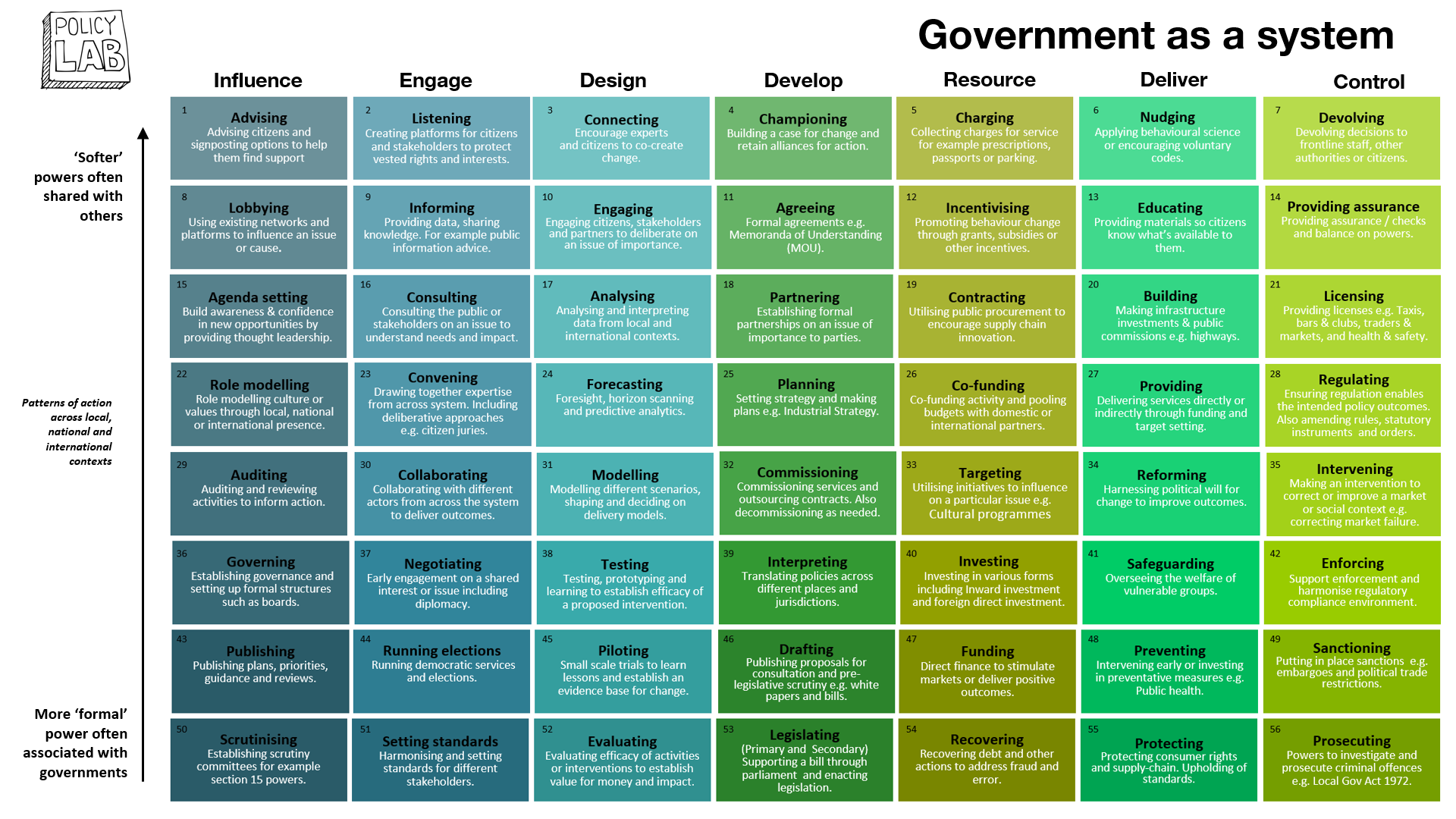
Returning to the Jobcentre example, focusing on staff training works through the ‘resource’ and ‘deliver’ columns. But the ‘control’ column might take us somewhere different, changing which part of the state makes the decisions. You might ask whether local authorities, rather than central government, are better placed to provide flexible support, because they have an interest in connecting people to wider help with things like housing and debt. That’s potentially a structural fix to the same problem, reached by pulling a different lever.
A practical way of using the grid in your own work is to imagine you are constrained to just one column and try to generate ideas which fit. Then move on to the next one. Some of what you develop might be a real stretch. But by the end you’ll be left with a longlist of potential policy solutions including a few that might be both promising and genuinely new.
3 Give your reader the first step
One of the problems with big bold policy solutions is that it can be hard to know how to start implementing them.
In some ways this is a campaigning problem. When an institution feels overwhelming political or public pressure to do something it may well find the route to making it happen. But often we’re influencing in the grey, trying to push for changes which are winnable but at risk of being crowded out by other priorities. In those situations there’s a benefit to reducing the friction involved in saying yes to what we’re asking for.
This involves trying to develop our best working model of the institutions we’re influencing and of how our proposal interacts with them. Are we asking for new investment, or new legislation? And what needs to happen within government to get to that point? If thinking about the UK government, the Institute for Government is a brilliant resource for this, particularly their ‘Ministers Reflect’ series. Their quote bank has insights from 130 conversations with Ministers, searchable by topics like ‘policymaking’, ‘legislation’, ‘setting priorities’ and ‘input from external groups’.
To stay on the employment support theme, anyone following Sir Charles Mayfield’s review into health and employment might have noticed how many of the recommendations talk about building evidence in time for the next spending review. We can debate the strategy and how far we need to wait for more evidence in order to act. But the logic behind what the review is doing is clear. We need new investment to make things happen, the issue affects multiple government departments, and so the best way forward is to be in a position to make as strong a case as possible ahead of the next spending review.
If you’re recommending a complex legislative change, would that need detailed thinking from the Law Commission or other experts? Or are there very specific pieces of evidence the government would need to commission before it could implement your proposal? This last question might involve taking a realistic look at the strengths and constraints of the evidence you’re currently working from.
A useful thought exercise is to imagine a politician or policymaker entirely sympathetic to your proposal has just taken up post. Who would they need to meet with and what would they need to ask for to start to make things happen? If you can distil the most important steps into a line or two, you’ll have a recommendation that both sets a direction and provides a guide for action.
Any resources, pitfalls or bits of advice I’ve missed? I’d love for you to share them below.
If you’re looking for training, coaching or consultancy support on an influencing issue, you can find out more or book a call at my website.